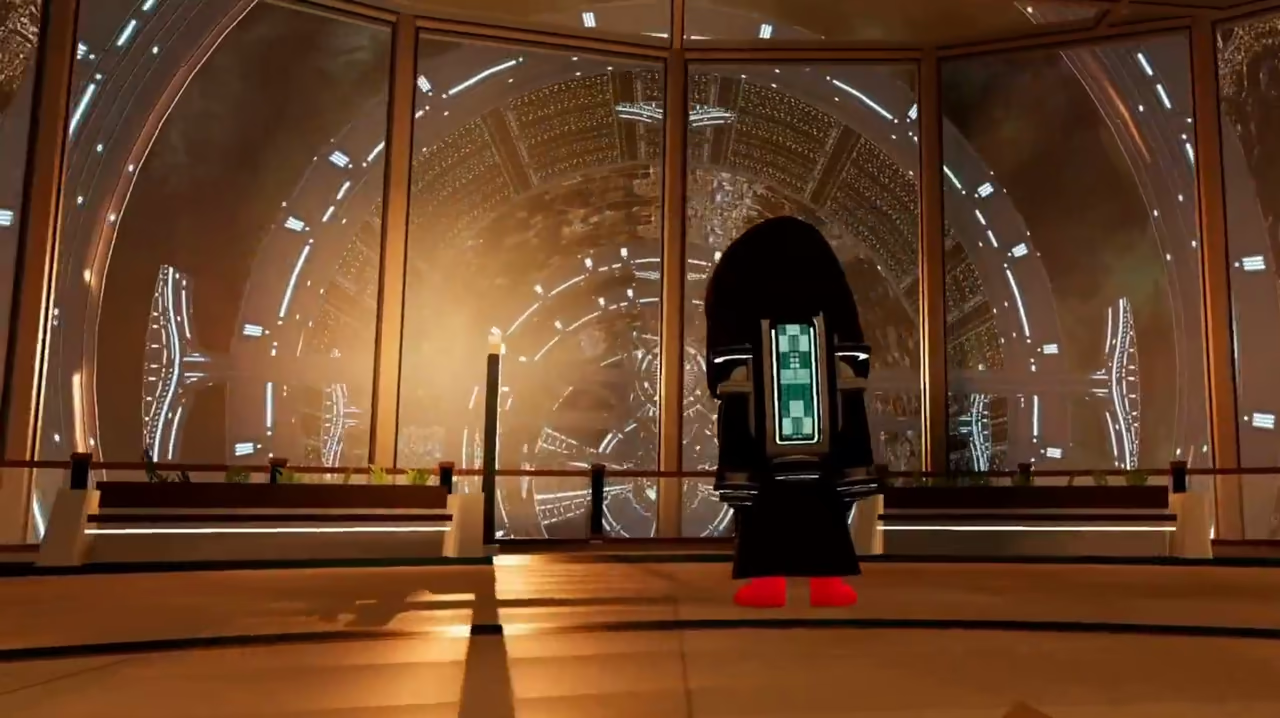

There is a criticism that follows every game that says it teaches. It is said of Prodigy. It is said of Minecraft when it turns up in a classroom, and of anything on Roblox that calls itself educational. It is said of us, too: there is too much game in this, and not enough learning.
We want to answer it in the open, for two reasons. It is a fair criticism. And the way we answer it decides almost everything about how Fronterra is built.
The short version
- Fronterra is a game first, and that is a choice, not an accident. We think a child who wants to come back will learn more over the years than a child who is made to sit through something they dread.
- We are running a marathon, not a sprint. The test is not how much science fits into one session. It is whether a child is still playing, and still learning, a year from now.
- The choice has real risks. We name them below, and we would rather hear where we are wrong than be told we are right.
The line every learning game has to draw
Picture a line. At one end is a worksheet with points on it: the questions are the product, and the game is a coat of paint. People who make games have a name for this, chocolate-covered broccoli, and children can taste the broccoli in about a minute.
At the other end is pure entertainment with a thin layer of learning on top: a real game, where the lesson is easy to skip.
Try it
Slide the game along the line
Chocolate-covered broccoli
A worksheet with points on it
The player
Ice cream with a broccoli sprinkle
A game where the lesson is easy to skip
- Learning in each minute
- How long they stay
- Learning that sticks
The sweet spot. The play is the learning, so they keep coming back for more.
Every learning game picks a place to stand on that line, and every one of them is criticised from both sides. Teachers ask where the learning went. Children ask where the fun went. Both are usually right about something. A game can have “educational” on the box and still let an hour go by with one sum in it. A lesson can be accurate, well sequenced and standards-aligned, and still be closed after five minutes and never opened again.
We stand closer to the game end than most people expect from a science product. Here is why.
Attention is the thing we are competing for
A twelve-year-old’s free hour is one of the most fought-over things in the world. Some of the best-funded, most carefully tuned entertainment ever made is competing for it, and it is very good at winning.
So the choice a child makes at half past four on a Tuesday is not between Fronterra and a textbook. It is between Fronterra and everything else on the screen. If we are not fun enough to be chosen freely, it does not matter how good our science is, because nobody is there to learn it.
A lesson nobody turns up for teaches nothing.
That is the uncomfortable starting point. We can build the most rigorous science course in the world and lose to a game about nothing, every afternoon, for years.
A marathon, not a sprint
The years between ten and fourteen are long. A heavy, lesson-first product can win a week of them: a parent sets it up, a child does what they are asked, and the numbers look good. Then the child stops wanting to open it, and everything it could have taught after that is lost.
What adds up is coming back. If a child plays through these years because they want to, and meets a new idea each time they do, the small exposures compound. That is also how memory tends to work: an idea met again and again over months sticks better than an idea crammed once.
So the standard we hold ourselves to is simple to say and hard to meet. Every time a child plays, they should leave knowing something they did not know when they sat down. It does not need to be a full lesson. It needs to be something real, every session, for years.
That is why a Fronterra mission is built from a few small pieces of science, which we call knowledge bytes, and not from a chapter. There are hundreds of them, covering every NGSS middle school standard and the KS3 science concepts, and each one comes at three levels, from Foundation to Advanced. A child meets them while flying, building and exploring, and keeps meeting them as the worlds get harder.
What that hour would have been otherwise
It is tempting to compare an hour in a learning game with an hour of perfect, focused study. That is rarely the real comparison. The real one is with the hour that child would have spent anyway.
For a lot of children, that is an hour in a game whose whole point is shooting each other, or an hour spent working out how to ask a parent for more in-game currency, to buy something that does nothing.
We do not think those games are evil. Children get real things from them: friends, creativity, the feeling of getting good at something hard. We want Fronterra to give them those things too. And we should be straight about our own game: Fronterra has shooter-style games, because children love them. Ours never show blood, gore or real-looking weapons, and a parent can switch them off.
The difference we care about is what is left when the hour is over. In Fronterra, outfits, dances and vehicles are earned by playing and can never be bought. Real money only unlocks learning, and only with a parent’s OK. And somewhere inside that hour, a child has met a piece of real science.
Measured over one afternoon, that is a small difference. Measured over four years, we think it is a very large one.
What we might be getting wrong
We have made this choice on purpose, and we would be fooling ourselves if we pretended it was safe. These are the risks we see.
The fun could crowd out the learning. A child can fly a jetpack around Mars for a long time. If the science ever becomes decoration, something to click through on the way to the good part, then the critics are right and we have built one more game. This is the risk we think about most.
Learning without noticing may not go deep enough. Some understanding only comes from effort: getting stuck, being wrong, trying again. Meeting an idea is not the same as mastering it. The three levels of each knowledge byte are our answer, but a game is not a teacher, a lab or a good conversation at dinner, and it should not pretend to be.
We cannot prove the long game yet. Our argument is about years, and Fronterra is new. We do not have years of evidence. It is a reasoned bet, and it is still a bet.
It is still screen time. Better screen time is still time on a screen. That is why parents can set a daily limit and quiet hours, and why, when time is up, a child finishes the question they are on and their progress is saved.
The choice, made on purpose
We would rather be honestly a game that teaches than a lesson dressed up as a game. Children can tell the difference straight away, and they vote with their time.
We could be wrong about where we have drawn the line. If we are, we expect to find out in the places that matter: children who play for months and cannot explain what they learned, or parents and teachers who watch them play and see no science in it. If that is what you are seeing, it is exactly what we need to know.
Tell us where we are wrong
This is a criticism we want to hear, not one we want to win. If you are a parent, a teacher or a researcher and you think we have drawn the line in the wrong place, write to us at hi@playfronterra.com. Tell us what you saw, and what you would change.
You can also judge it for yourself. Fronterra is free to start, and a parent’s account is a player account too. Play a mission, then decide which side of the line we are on.
Questions people ask us
Is Fronterra a game or a learning tool?
Both, in that order. Fronterra is a 3D adventure game that children choose to play, and every mission in it is built from real middle school science. We put the game first on purpose: a child who wants to come back will learn more over the years than one who has to be made to.
Does my child actually learn science by playing?
Every mission is built from knowledge bytes, small pieces of science mapped to the NGSS middle school standards and to Key Stage 3 science, and each one is taught at Foundation, Intermediate and Advanced level. What we cannot promise is that a game replaces a teacher. We think of Fronterra as years of steady exposure to real science, alongside school.
How is Fronterra different from Roblox, Minecraft or Prodigy?
Like Roblox and Minecraft, Fronterra is an open 3D world to explore, build and play in. Unlike them, every world and mission is made by our team, there is no chat between players, and every mission teaches science. Like Prodigy, it is an adventure built around school learning; ours is science for ages 10 to 14, and money only buys learning, never outfits or random prizes.
Is there too much gaming in Fronterra?
It is a fair question, and we take it seriously. Fronterra is a game first by design, because a game children choose is one they keep learning from. The risk is that the fun crowds out the science, and if you see that happening, we want to hear from you at hi@playfronterra.com.
Can I limit how long my child plays?
Yes. A parent can set a daily limit and quiet hours. When time is up, a child finishes the question they are on and their progress is saved.