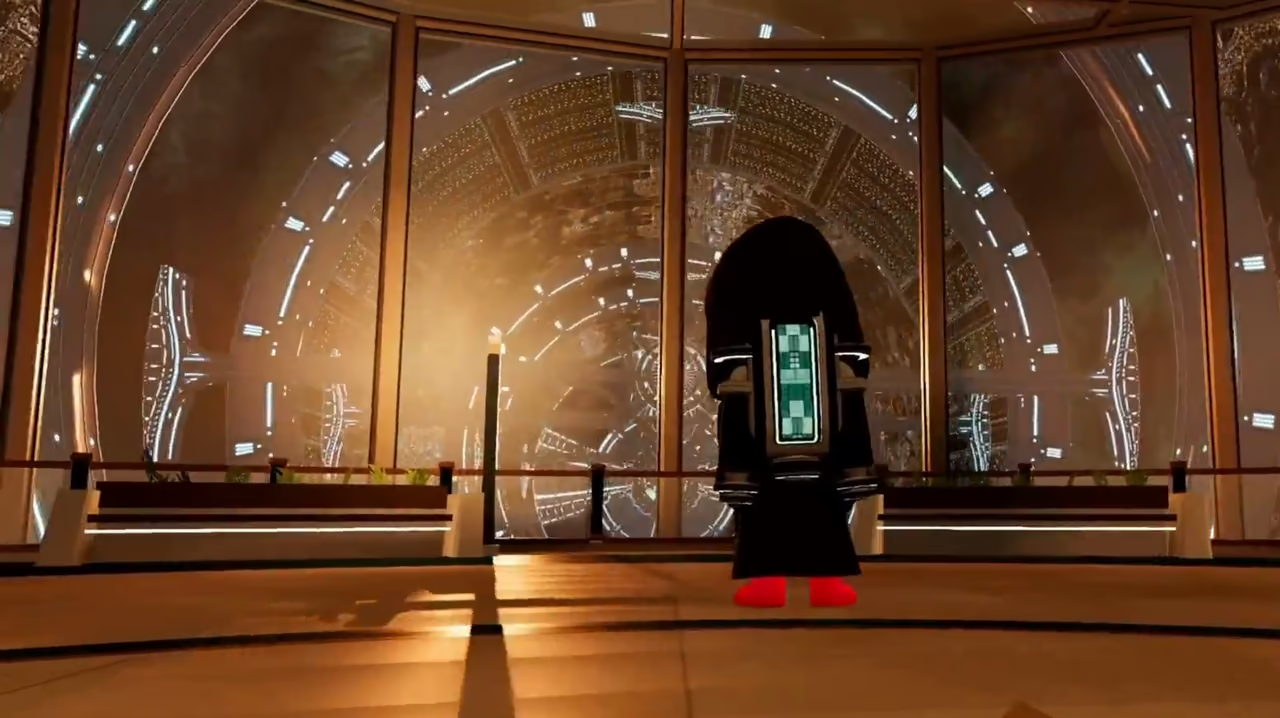


Fronterra has shooter games. In Paintball, players splat each other and the Mechatrons, the grey machines of the Apathy, with paint. In Curiosity Blaster, they fire beams of light. Both can be played alone or with a crew of friends.

This was not an easy choice for a learning game. We argued about it for a long time. In the end we decided to build them, carefully, and to give every parent a switch that removes them. This post explains why.
The short version
- Kids already love these games. The most popular games children play are full of aiming and firing. Pretending that away does not make a game safer, only easier to ignore.
- The research does not show that games make kids violent. The American Psychological Association says blaming violence on video games "is not scientifically sound." It does find a small link to everyday aggression, which we take seriously.
- Ours are fantasy, through and through. Paint and light, never bullets. No blood, no gore, no real-looking weapons. A Mechatron that is hit turns to light and is set free.
- Every shooter is a learning game. Questions from the player's learning pack reload their blaster and bring them back after a hit.
- Parents decide. One switch in the parent portal removes every shooter game, and everything else plays the same.
Why we did not just leave them out
The easiest choice would have been no shooters at all. We would never have had to write this post.
But it would have left a lot of children behind. The 2021 Common Sense census of 8 to 18 year olds in the US found that video games are the activity most "split along gender lines": 60% of boys said they enjoy playing them "a lot", against 24% of girls. Boys averaged 2 hours 20 minutes a day of gaming, girls just under an hour. (Common Sense Media, 2021)
Many of those children spend that time in games built around aiming and firing. Fortnite, which many children play, is rated T for Teen by the ESRB for "Animated Blood" and "Violence". (ESRB) On Roblox, children can play games that include violence, as long as it is not realistic or extreme. The platform says "realistic violence often requires higher content ratings" and that it "doesn't allow content that contains extreme violence." (Roblox)
We want Fronterra to reach the child who would never pick a quiz but will happily play a game of paintball with friends. So we made a deliberate choice: shooters are one of the ways we bring those children in, and every shooter we build is also a learning game.
What the research says
This is the question every parent asks, so we looked at what the research actually says, not what the headlines say.
Games do not cause violence. The American Psychological Association reviewed the evidence in 2020. Its resolution opens with a warning against blaming "violence, such as mass shootings, to violent video game use," and says: "Attributing violence to violent video gaming is not scientifically sound and draws attention away from other factors." (APA, 2020)
There is a small link to aggression, and we do not ignore it. The same resolution finds that violent game play is associated with more "aggressive behavior, aggressive affect, aggressive cognitions" and with less empathy. Aggression here means everyday things like insults and pushing, measured over short periods. The APA calls violent game use "one such risk factor" among many, and notes that the research "has not focused on lethal violence as an outcome."
Over time, that link shrinks toward nothing. A 2020 meta-analysis by Aaron Drummond, James Sauer and Christopher Ferguson pooled long-term studies covering "approximately 21 000 youth." The overall effect was tiny (r = 0.059), and "studies with more best practices were statistically indistinguishable from zero." Their conclusion: "longitudinal studies do not appear to support substantive long-term links." (Drummond, Sauer and Ferguson, 2020)
Action games can build real skills. In a review for American Psychologist, Isabela Granic, Adam Lobel and Rutger Engels describe training studies where people who played shooter games showed "faster and more accurate attention allocation" and "enhanced mental rotation abilities." One meta-analysis found these spatial gains were "comparable to the effects of formal (high school and university-level) courses" in the same skills, and spatial skills predict success in science, technology, engineering and maths. (Granic, Lobel and Engels, 2014)
What matters is how violence is shown. The ESRB, which rates games in the US, separates "Fantasy Violence", meaning "violent actions of a fantasy nature" in "situations easily distinguishable from real life", from "Blood and Gore" and "Intense Violence", meaning "graphic and realistic-looking depictions of physical conflict." (ESRB ratings guide) The APA itself asks for research on "type and degree of violence" and on "the role of competition and cooperation." We built every shooter to sit firmly on the fantasy side of that line.
How our shooters are made
Here are the rules every Fronterra shooter follows.
- Paint and light, never bullets. Blasters fire paint balls or beams of light. Nothing looks like a real gun.
- No blood, no gore, ever. A hit is a splat of paint or a flash of light. Nobody is hurt, and nobody dies.
- You set the Mechatrons free. In the story, a Mechatron is an explorer whose curiosity was dimmed by the Apathy until they hardened into a machine. When one is hit, it turns to light and a small spirit goes free. The point is rescue, not destruction.
- Mechatrons only live in Akasha, the realm of thought, never in the real places players explore.
- Learning is the ammunition. A blaster that runs dry is recharged by answering a question from the player's learning pack: a right answer fills it, a wrong one half fills it. In some games, a player who is hit waits inside a shield until one question brings them back.
- Played with friends, not strangers. Multiplayer rounds are played with your own crew, joined by a code a friend shows you.
- No chat, no strangers. Shooters follow the same safety rules as the rest of Fronterra: generated names, no typed messages, and friends only by both saying yes.


You can switch them off
We know that not every family will agree with our choice, and that is fine. Some children are more sensitive, some homes have their own rules, and some parents simply do not want aiming and firing in a learning game.
So every linked parent has a switch. In the parent portal, under the child's controls, Allow shooter games is on by default. Switch it off and every shooter game is removed for that child:
- they are not shown in the arcade;
- they are not offered when the child's crew picks a game;
- if a friend's crew heads to one, the child is told their grown-up has turned shooter games off, and stays where they are.

Everything else in Fronterra plays exactly the same. Nobody else is told, and the child is never punished for it. The choice takes effect the next time the game loads.
What we might be getting wrong
We think this is the right choice, but it has real costs.
A small link to aggression is still a link. The research does not show that games make children violent, but it does show short-term effects on aggressive thoughts and feelings in some studies. We have tried to keep our games on the gentlest side of every line the research draws, and we will keep watching the evidence.
Fantasy violence is still aiming at someone. Paint is not a bullet, but a child is still pointing a blaster at another player. Some families will not be comfortable with that, which is exactly why the switch exists.
We are using shooters to reach some children. That is a deliberate choice to bring in kids who might not otherwise play a learning game. We think it is honest to say so, and we will judge it by whether those children end up learning, not just playing.
The research is not about our games. Most studies looked at commercial games, many far more violent than ours. None of them tested a learning shooter where reloading asks a question.
Why we went for it
We could have built a learning game that only some children want to play. We would rather build one that meets children where they already are, keeps the fun, and takes out the parts that do not belong in a game for kids: the blood, the gore, the real weapons and the strangers.
If you are a parent, teacher or researcher and you see something we have missed, write to us at hi@playfronterra.com. And if you want to see the switch for yourself, a parent's account is a player account too.
Questions people ask us
Does Fronterra have violent games?
Fronterra has shooter games where players fire paint or beams of light. There is no blood, no gore and no real-looking weapons. When a Mechatron, the game's machine enemy, is hit, it turns to light and is set free.
Do video games make kids violent?
The American Psychological Association says attributing violence to video games "is not scientifically sound." Research does find a small link to everyday aggression, and long-term studies find that link is very small and shrinks to near zero in the best-designed studies.
Can I turn off shooter games for my child?
Yes. In the parent portal, switch off "Allow shooter games" in your child's controls. Every shooter game is removed for your child, and the rest of Fronterra plays the same.
What happens if my child's friends play a shooter game?
If a crew heads to a shooter game, a child whose grown-up has switched shooters off is told so and stays where they are. They can keep playing everything else with their friends.
Are the shooter games educational?
Yes. In Fronterra's shooters, questions from the child's learning pack recharge their blaster and bring them back into the game after a hit. Research also links action games to better attention and spatial skills.